
What software actually tracks tooling history and die maintenance?
Tool trackers built for construction crews and CMMS built for pumps both miss what a die record has to hold. The software question is really a records question: repairs, services, counts and spares as one story that reads back on demand.
Search for software to track dies and you will wade through tool trackers built for construction crews, maintenance platforms built for pumps and compressors, and ERP modules that treat a die as a line on a bill of materials. Meanwhile the real question is narrow and concrete. A production die is forming parts every shift, wearing with every hit, getting repaired, getting serviced, consuming spares. Somewhere all of that has to be written down in a way that can be read back years later. The software question is really a records question: what has to be captured, and what has to come back out.
A die record is not an equipment record
A pump has a service history. A die has a life story. It arrives with a build standard, runs a job, gets repaired after a section chips, has its clearances checked, gets a punch replaced from the spares shelf, and accumulates hits the whole time. The record that describes it has to hold all of that in one place: the repairs and what caused them, the preventive services and the produced-part count each one ran to, the job cards raised against it, the spares fitted, and the state it is in right now. Scatter those threads across systems and the die has no story, only fragments, and every question about it becomes a reconstruction job.
The four places die records usually live
- Spreadsheets. Free and familiar, and fine for a handful of tools. But the history lives in whoever built the sheet, rows get overwritten rather than appended, and a die's repairs, services and spares end up in three files that do not agree.
- A general CMMS. Strong on facility equipment and work-order flow, and many can trigger PM from a meter reading. But a die is just another equipment record to it. The produced-part count, the repair root cause and the tooling spares usually sit in custom fields at the edge of the system rather than at the centre of the record.
- An ERP or MES tooling module. Close to production data, so counts are often available. But maintenance depth is usually thin, the toolroom works in someone else's system, and the history is only as reachable as the ERP makes it.
- Dedicated tooling management software. Built around the tool record itself, so the die's repairs, PM, job cards and spares are one story. The trade-off is that it will not run your building's HVAC, and it should not try.
The first test is whether it can trigger PM from produced parts
Whatever the category, the first capability test is specific. Can a preventive maintenance plan be triggered by the produced-part count, not just the calendar? A die wears by the hits it makes, so a service scheduled every six weeks is a guess that runs too late for a busy die and too often for an idle one. Look for maintenance intervals expressed in produced parts, a current count held on the die record, and a service record that stores the count it was performed at. If the answer is a calendar field and a hope that someone remembers the counter, the software is scheduling around the die rather than reading it.
The second test is whether the history answers questions
The second test arrives later, when a customer or an auditor asks for the maintenance history of a specific die over a specific period. The honest measure of tracking software is not what it captures but what it can produce on demand: every service on this die between these dates, with who did it, what was found and what count it ran to. If assembling that answer means exporting three reports and cross-referencing them in a spreadsheet, the history exists but it does not answer, and a record that cannot be produced fails the question just as surely as a record that was never kept.
Where VoraTool sits
VoraTool is dedicated tooling management for production facilities that run moulds, dies, fixtures and gauges, the injection moulding, die casting and stamping world. Preventive maintenance plans are set in days, weeks, months, years or produced parts, and each completed PM event stores the produced-part count it ran to alongside the interval and the outcome. Repairs run on job cards with root cause, critical spares carry minimum stock levels, and the toolroom planning board turns due work into scheduled days for named toolmakers. Because it is part of VoraSuite, the same records feed VoraAudit, which answers a request for the maintenance evidence on a die as a filtered, printable report rather than a reconstruction. It is not a facility CMMS and does not want to be; the building's compressors deserve their own system.
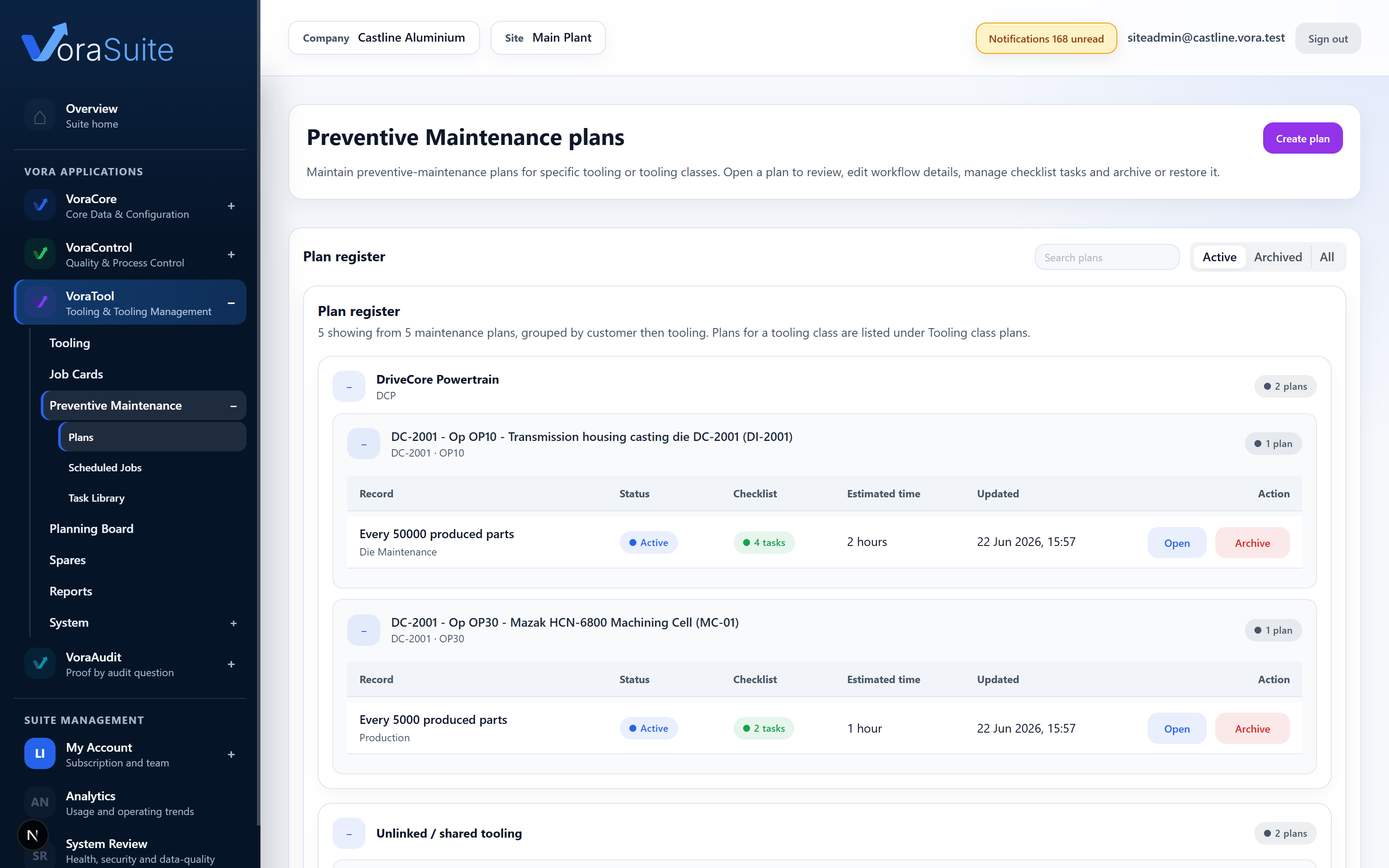
Ask each candidate the same six questions. Can PM be triggered by produced parts? Does the service record store the count it ran to? Do repairs carry a root cause? Are spares tied to the tool that consumes them? Can the toolroom plan the due work onto real days? And can the whole history of one die over one period be produced as a single report? The software that answers all six is tracking the die. The rest are tracking dates.
Tooling, job cards and preventive maintenance with the history written as the work happens.
Talk to someone who understands manufacturing control and audit evidence. We do not do generic demos.